Yokogawa closes the loop on polymerization control
Produced with support from Yokogawa
This show takeover was sponsored by our YNOW2026 coverage partner, Yokogawa. See more coverage on our YNOW2026 page.
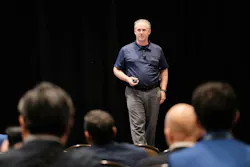
During YNOW2026, A Yokogawa Users Conference & Exhibition, Michael Drenski, Technical Consultant at Yokogawa Fluence Analytics, described how automatic continuous online monitoring of polymerization (ACOMP) can provide real-time measurements of polymer characteristics and potentially turn measurements into control variables. The long-term objective is closed-loop polymerization control and—ultimately—autonomy.
The traditional procedure to determine what is happening inside the reactor has been to extract a physical sample, carry it to a laboratory, analyze it and then use the results to dictate next steps in the process. Inefficient, to say the least.
The transition from industrial automation to industrial autonomy is where polymer manufacturers need to go, Drenski stressed. “ACOMP is another tool that we’re going to try to use to make that happen.”
The problem with waiting for the lab
Traditional polymer-process characterization follows that inefficient process detailed above, with the sample then being tested for molecular weight, viscosity, concentration, conversion or particle size before the information makes its way back to an operator. This process can take as long as five hours. Besides delaying control decisions, manual sampling exposes personnel to potentially hazardous process environments. And, as always, it adds human error into the equation.
More recent technologies, including nuclear magnetic resonance (NMR), Fourier-transform infrared spectroscopy (FTIR) and Raman spectroscopy, have shortened the feedback cycle. But much of the information used for process control is still inferential, said Drenski.
Measurements such as temperature, pressure, flow and torque can help determine what is happening in a reactor, but they don't necessarily characterize the macromolecular properties that determine the polymer product. ACOMP is intended to close that gap.
The technology continuously extracts a small amount of product from the reactor, conditions and dilutes the sample, then sends it through detectors capable of characterizing properties such as weight-average molecular weight, intrinsic viscosity, concentration, conversion and composition.
The process-to-detector delay can range from about 30 seconds to five minutes, depending on the conditioning required. Once the sample reaches the measurement system, ACOMP can collect data at one point per second. That continuous stream can reveal process disturbances quickly, rather than forcing operators to wait hours for a lab result, and empower teams to make necessary changes much more rapidly.
From Tulane to Yokogawa
ACOMP’s origins date to research begun by Professor Wayne Reed at Tulane University in New Orleans. Drenski, a physicist by training, joined the effort in 2001 and helped develop the technology needed to continuously condition and analyze polymer samples.
The technology eventually became the foundation for Fluence Analytics, which Drenski co-founded with Reed’s son in 2013 and where he served as chief technology officer. Yokogawa Electric acquired Fluence Analytics in 2023.
An early industrial application demonstrated the potential economic impact of faster polymer analysis. A producer needed to increase polymer output, and ACOMP provided a way to determine when a batch had finished, without waiting for lab results.
Instead of holding up a reactor while waiting for confirmation, the manufacturer could discharge the completed polymer and begin another batch, which enabled an additional batch per day on a reactor in some cases, creating the potential for a rapid return on the technology investment, explained Drenski.
Control the polymer, not the reactor
Monitoring polymer characteristics in real time is only part of the opportunity Drenski described. Those measurements can be used to actively steer polymerization. In one experiment involving free-radical batch polymerization of acrylamide, researchers controlled monomer concentration so that it followed an intentionally selected sinusoidal pattern, rather than its natural decline as monomer was converted into polymer. The system achieved a 2 percent error while monitoring and controlling concentration every second.
The researchers then took the concept further by controlling molecular weight, which normally followed a natural downward trajectory. Instead, the researchers fed monomer into the reactor to force molecular weight upward along a predetermined path. “We thumbed our nose at nature and decided to drive the molecular weight up,” Drenski joked.
The implications extend beyond simply hitting a molecular-weight target. Manufacturers potentially could control composition and branching characteristics, as well, producing polymer properties dynamically.
ACOMP has also demonstrated its ability to observe these characteristics in industrial processes. Drenski described work involving solution styrene-butadiene rubber in which continuous measurements tracked monomer conversion and molecular characteristics as the reaction progressed and a branching agent was introduced.
The ACOMP-control system connection
The next challenge is integrating these capabilities with Yokogawa’s process-control ecosystem. Drenski envisions ACOMP measurements becoming continuous process variables alongside familiar measurements such as temperature, pressure and flow. State-space models and multivariable control algorithms could compare measured polymer characteristics with a desired trajectory and calculate the adjustments necessary to keep the reaction on target. Those changes could include monomer and initiator feed rates, temperature, pressure and other variables.
Data from ACOMP would move into an automatic feedback-control loop and then through an advanced process-control layer to the distributed control system (DCS). The DCS and underlying controllers could execute the necessary changes while maintaining process interlocks and safety constraints.
That safety layer is essential. Increasing monomer flow, for example, cannot be allowed to push the reactor outside safe operating limits simply because a control algorithm determines that additional monomer would improve the polymer's molecular characteristics.
Naturally, this integration remains a work in progress. But the direction is clear: instead of controlling a polymerization process primarily by maintaining reactor conditions and hoping those conditions produce the desired polymer, manufacturers could directly measure the characteristics that matter and use them as feedback variables, Drenski explained.
The goal is to use physical control variables to dynamically steer macromolecular characteristics and properties of the polymer, moving this field of manufacturing another step closer to true autonomous operation.
About the Author
 Mike Bacidore
 Mike Bacidore
Control Design
Mike Bacidore is chief editor of Control Design and has been an integral part of the Endeavor Business Media editorial team since 2007. Previously, he was editorial director at Hughes Communications and a portfolio manager of the human resources and labor law areas at Wolters Kluwer. Bacidore holds a BA from the University of Illinois and an MBA from Lake Forest Graduate School of Management. He is an award-winning columnist, earning multiple regional and national awards from the American Society of Business Publication Editors. He may be reached at [email protected]