Action vs. reaction: embracing true proactive manufacturing
Produced with support from Yokogawa
This show takeover was sponsored by our YNOW2026 coverage partner, Yokogawa. See more coverage on our YNOW2026 page.
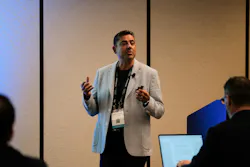
Manufacturers around the globe are wasting some $5 trillion a year due to reactive optimization processes. “That’s a lot of wasted raw material, energy, and operators’ time,” said Karim Pourak, CEO & Co-founder of Atlanta, Georgia-based ProcessMiner, during his YNOW2026 presentation on fixing that problem—in short—transforming industry’s problem-solving process from reactive to proactive with comprehensive autonomous optimization that can be deployed through existing plant infrastructure to deliver true, substantial, measurable efficiency wins. Getting proactive to trim those trillions in waste.
Pourak used a paper-towel-producing process as an example. The machines and raw materials are prepped, the rolls of towels are produced, then operators take a sample to the lab for testing to determine if the swatch adheres to the wet-tensile strength test to determine durability while damp. If the paper passes the test, production continues. If the paper falls apart, the team must adjust formulas and manipulate the machinery before starting again.
Wasted raw materials. Wasted paper. Wasted time. Wasted money.
Strong process, strong product
The fix is applying closed-loop AI optimization to improve quality, reduce raw material consumption, and enhance sustainability in continuous-manufacturing environments. And the methods for doing so are becoming more accessible by the day, explained the presenter.
“We have new capabilities for proactive optimization,” said Pourak, referencing his team’s system-agnostic PM Studio solution that taps into a client’s data historian to build models aligned with custom quality parameters, then ingests real-time process data to analyze production conditions every 30 second, and provide adjustment recommendations every 15 minutes to those at the helm. A quicker picker-upper, you could say.
In that paper-towel use case he demonstrated to the show attendees, Pourak cited how his team’s optimization initiative resulted in a 25 percent reduction of chemistry requirements for the client, nearly 30 percent reduction in quality variation, and a 63 percent increase in target adherence.
Launching more than a decade ago, the ProcessMiner team learned early on that convincing operators to embrace a truly proactive, heavily autonomous approach to asset maintenance would take time. “Change management was a problem,” said the CEO. “And operators are often acting as firefighters on the plant floor, running around addressing problems.”
Speedier insights into process fluctuations extinguished many of those fires, but it took some time to make that evident to operators. Critical was enabling them to optimize the platform to their own needs, based on their own data, and retain ownership (human ownership) of certain processes. Pourak cited that within his deployments, about half of decisions are autonomous, and half continue to be managed by living, breathing personnel.
These proactive processes eliminate wasted time, effort and money, of course, but over time the insights aggregate to reveal process patterns about formula usage and raw-material needs. In scenarios when operators would overfeed resin or fiber into a process in order to achieve production targets, they are now able to confidently reduce material inputs and accurately dose the chemistry to exact outcomes. Efficiency, after all, is sustainability.
And while Pourak’s use case during his YNOW presentation focused on pulp and paper, he stressed how the approach is platform-agnostic and applicable for any continuous or semi-continuous manufacturing processes. Programs can be built with zero code, and customers can define all parameters, even those parameters that contradict one another, a wrinkle that can often undermine accurate data analysis in traditional programs.
Early warnings
Real-time root-cause analysis can provide early warning of process drift. And operators can immediately access the most likely variables causing those drifts. Artificial intelligence—informed by everything from the manufacturer’s historical data to its operator manuals, its activity logs to its machine schematics—alerts to anomalies and suggests solution paths.
Lastly, the presented spotlighted the goal at the center of his company’s Centerlining solution, which tracks key variables inside grade-specific target corridors (aka the parameters that define a “golden run” for a manufacturer’s product). The goal is to remain inside that “golden run” with every production process, with the machine informing the operator how it feels in real time while it is running. Operator…I am seeing drift. Here is the root cause and here is how that ties back into activity logs.
“For the first time we are really seeing how this data is tying back to all processes,” said Pourak. “The health and well-being of the machines becomes evident and insightful to the operator. These are trouble-shooting tools. These are educational tools.”