Black box recorder for modern plants
Three tribes exist in every process plant, and they don't always get along. Operations engineers want to keep production running. IT and analytics teams want access to machine data to improve performance and feed increasingly sophisticated AI applications. Cybersecurity professionals want to ensure that none of these activities compromise the control network.
All three have legitimate requirements. Unfortunately, traditional data collection approaches often satisfy one group at the expense of another. To resolve these conflicts, Real Time Automation (RTA) has developed its Historian 2.0 to fulfill the different requirements and priorities of these teams.
“Think of Historian 2.0 as a black box flight-data recorder for manufacturing equipment and other high-value industrial assets,” says John Rinaldi, CEO of RTA. “Similar to a flight-data recorder, it continuously captures detailed operating information, preserving the data needed to investigate failures, understand performance, and reconstruct events. However, capturing information is only half the challenge. That data must also be accessible, meaningful and secure.”
Consequently, Historian 2.0 collects high-fidelity information from Allen-Bradley, Siemens, Modbus and other suppliers’ control networks and protocols. It supports millisecond-level data capture, event-driven recording, and scheduled collection at the end of a job, shift, calendar date or other predefined intervals.
Before storage, raw values can be scaled, normalized, and organized into contextual data models. Built around Tiger Data’s (https://www.tigerdata.com) TimescaleDB time-series analysis database, Historian 2.0 preserves detailed operating histories, while supporting structured information required by modern analytics and AI applications.
An appliance, not another IT project
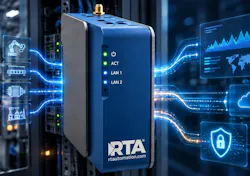
While software-based historians typically require costly, complex and possibly disruptive servers, operating system maintenance, software updates and ongoing IT involvement, RTA took a different approach. Historian 2.0 employs a solid-state, Linux-based hardware appliance mounted in a control cabinet. Its fanless architecture supports operating temperatures up to 60 °C, eliminating the need for a conventional computer or dedicated server.
Two isolated network interfaces separate control system traffic from “northbound” information system traffic. Combined with user-level access controls and an architecture designed around IEC 62443 cybersecurity principles, this appliance provides a controlled path for moving operational information beyond the machine.
“For plant engineers, installation and operation resemble those of a familiar, quickly installed industrial gateway, rather than a traditional IT system,” explains Rinaldi. “Historian 2.0 is a 10-minute installation, requiring no VMs, servers, software downloads, and best of all, no subscriptions.”
From raw data to useful information
To give users more than timestamped values, and show how measurements relate to processes, Historian 2.0 supports contextual data modeling that can incorporate asset identification, equipment relationships, engineering units and other metadata. These models can be developed by controls engineers or derived from control-system structures, providing a foundation for future enterprise-wide modeling.
Consequently, the appliance supports multiple northbound interfaces, including SQL, MQTT, OPC UA, MCP, FTP and USB-based data transfer. Support for emerging CESMII i3X interfaces lets it share contextualized information.
“This flexibility means the same device can serve a maintenance technician investigating an intermittent fault, an analytics team feeding machine data into AI research, and everything in between,” adds Rinaldi. “However, we don't view Historian 2.0 as a replacement for large enterprise historians. It proposes a complementary architecture—machine-level ‘little h’ Historian 2.0 working alongside enterprise ‘Big H’ historians. Little h captures high-speed, high-fidelity information close to the process, including details that might never reach enterprise systems. Big H consolidates selected information across production lines, plants and business operations.”
This approach also allows data collection to continue locally during upstream network or application outages. The result is a practical division of responsibilities—operations retains the details needed to troubleshoot equipment, security teams maintain control over network access, and enterprise applications receive consistent, contextualized information. As manufacturers pursue AI-driven analytics, those distinctions become increasingly important.
“The future of manufacturing AI depends on trustworthy machine data,” concludes Rinaldi. “Historian 2.0 makes that data available without making processes more complicated.”