Intelligent edge controller combines deterministic control with open, AI-ready architecture
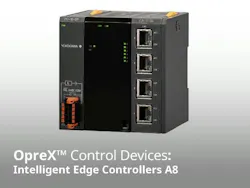
The A8 Series intelligent edge controller is an embedded control platform engineered to meet the growing demands of advanced industrial and semiconductor manufacturing equipment. As systems become more complex and precision requirements increase, conventional controllers—often tightly coupled to hardware—can slow development and limit scalability. The A8 addresses these challenges with a data-centric architecture, deterministic real-time performance, and an open, AI-ready software environment.
The A8 is built on Linux with real-time kernel enhancements, combining deterministic control performance with the flexibility of a widely adopted Linux ecosystem. This enables low-latency execution for time-critical applications such as motion control and high-speed process loops, while also supporting modern software tools and frameworks.
Drawing on Yokogawa’s proven FA-M3 and e-RT3 control technologies, the A8 maintains high reliability and performance while introducing a more flexible and scalable software architecture. This allows engineering teams to modernize control systems without compromising stability.
At the core of the A8 is its “Data Stream” architecture, which shifts control development from hardware-dependent programming to a data-centric model. All connected devices are managed through a unified data layer, where communication data are continuously updated in a streaming format. Control applications interact with this data using tag-based references rather than direct hardware addressing.
This abstraction provides several key benefits:
Hardware independence: Software can be reused across different system configurations.
Reduced development time: Engineers focus on functionality instead of low-level integration.
Simplified maintenance: Hardware changes can be accommodated without major software rewrites This approach is particularly valuable for OEMs and system integrators managing multiple equipment variants, enabling faster deployment and reduced engineering effort.
High-Precision Timing and Synchronization: The A8 applies ±1 microsecond timestamping to all data processed within the system. This enables time-based control strategies and provides precise visibility into system behavior.
The A8 Series enables more accurate and deterministic execution. Detailed traceability of system events for root-cause analysis. Consistent performance across repeated operations. For distributed systems, up to 16 A8 controllers can be synchronized, enabling coordinated control even in environments with communication delays. This capability supports applications such as multi-axis motion systems and distributed process control.
The A8 Series includes a comprehensive suite of built-in control libraries to accelerate system development. These include:
- Motion control for multi-axis coordination and positioning
- PID control for closed-loop process applications
- EtherCAT master support for high-speed, deterministic communication. These libraries are designed for seamless integration within the Data Stream framework, allowing engineers to create modular, reusable control components and reduce validation time.
The A8 supports a wide range of open-source software and AI frameworks, enabling enables engineers to develop advanced applications such as time-series data analysis, anomaly detection, and predictive maintenance models.
The inclusion of high-resolution timestamped data enhances the accuracy and effectiveness of these applications, particularly in environments where timing relationships are critical. The open architecture also simplifies integration with external systems, databases, and cloud platforms.
The A8 is designed to support a wide range of equipment sizes and complexities. Its architecture enables continuous high-speed data processing , modular and reusable software design, and scalable deployment from standalone machines to distributed systems. This flexibility makes the A8 suitable for applications ranging from individual equipment control to large-scale, multi-controller systems.