New products bring AI and edge computing closer to machine control
Produced with support from Rockwell Automation
This show takeover was sponsored by our Automation Fair coverage partner, Rockwell Automation. See more coverage on our Automation Fair page.
Rockwell Automation used Automation Fair 2026 in Boston to showcase a wide-ranging lineup of new products and software aimed at advancing industrial control, machine connectivity and AI-enabled manufacturing. From compact drives and next-generation controllers to software-defined automation and AI orchestration, the announcements offer machine builders and manufacturers several developments to watch.
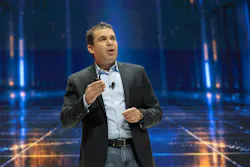
Matheus Bulho, Rockwell Automation's senior vice president of software & control, introduced the audience to the new developments during his keynote session. What follows below is a rapid-fire listing. All are worth checking out at the links provided.
New drives, controllers and I/O target more flexible machine architectures
The hardware introductions include a new compact variable-frequency drive, an integrated drive-and-motor solution, next-generation I/O and a controller designed to bring capabilities from its Logix platform to open industrial computing platforms.
Among the new offerings is the PowerFlex 535 low-voltage drive, a compact, high-density platform that Rockwell says delivers its highest level of motor-control performance in the compact drive category. The drive also incorporates cybersecurity features intended to help manufacturers address current security requirements.
The company is extending its on-machine portfolio with the Armor PowerFlex 330 Integrated Drive Motor, which combines motor and drive functionality in a compact assembly, and its PointMax I/O platform (Bulletin 5034). PointMax is designed to support modular machine architectures, with a range of standard, safety and specialty modules. New additions include a stepper module, expanded channel density and options intended to simplify migration from POINT I/O.
Keeping machine builders top of mind, Rockwell also introduced the EtherNet/IP In-cabinet Solution, which extends connectivity within control panels. The system is designed to simplify wiring and installation while providing access to device-level diagnostics and operational data.
Operator interface updates include the OptixPanel Pro and PanelView Pro graphic terminals. OptixPanel Pro is designed to run FactoryTalk Optix applications, supporting more demanding visualization and edge-computing requirements. PanelView Pro, meanwhile, is built for FactoryTalk View ME applications and is intended to help manufacturers modernize existing human-machine interfaces while retaining their application investments and familiar panel cutouts.
Industrial computing and control are another focus. Rockwell introduced the LogixEdge Controller, an industrial PC-based controller that combines embedded Logix control with containerized workloads. The architecture allows applications such as FactoryTalk Optix to run alongside the Logix engine, supporting IT/OT convergence and software-centric machine designs.
The company also introduced the CompactLogix 5390 Controller, extending capabilities from its ControlLogix L9 platform into the CompactLogix family. The controller is designed to provide enhanced performance, security and scalability for machine and production applications. It works with the PointMax I/O platform.
Rockwell is also advancing software-defined automation through Logix SDA, which separates control software from traditional hardware configurations. Bulho highlighted the potential to run multiple Logix instances on shared computing infrastructure, including a demonstration coordinating approximately 1,000 motion axes on a single computing platform. “It's about 1,000 axes of coordinated motion control on a single compute surface,” he said.
At the visualization layer, FactoryTalk Optix Version 1.9 adds support for larger distributed systems, including high availability across multiple nodes. Rockwell is also developing a marketplace for software workloads that can be integrated with Logix and Optix environments. Potential applications include third-party robotic operating systems, communications protocols, machine-learning workloads and operator-support tools.
AI and software-defined automation reshape engineering and production
The software announcements extend into manufacturing execution and maintenance. The Plex Smart Manufacturing Platform is gaining AI agents to assist with tasks such as authoring work instructions, answering production-performance questions and investigating quality issues. Within Fiix, Rockwell is adding agentic capabilities to maintenance workflows. Fiix Max can help automate maintenance work-order creation, while Fiix Asset Health includes a reliability agent intended to monitor equipment condition and support preventive maintenance.
Other software introductions include FactoryTalk AssetIQ, for enterprise OT asset management; FactoryTalk Design Workbench Version 2, which adds engineering capabilities for Micro800 controllers and PowerFlex 535 drives; and FactoryTalk ResilientEdge, aimed at improving the resilience of edge deployments.
The most significant software announcement is FactoryTalk Conductor, an AI-native orchestration platform intended to coordinate agents, engineering applications and workflows. Rather than functioning as a standalone assistant, Conductor is designed to connect multiple agents and software tools to carry out more complex engineering tasks through natural-language interactions.
At launch, planned for the first quarter of 2027, integrations will include Studio 5000 Logix Designer, Logix Echo, Emulate3D and FactoryTalk Optix. Additional connections to FactoryTalk Design Studio, FactoryTalk Historian, Plex and Fiix are planned for subsequent releases. Users will also be able to create their own agents and skills, drawing on internal engineering knowledge and company-specific practices.
“What makes FactoryTalk Conductor unique is the combination of AI orchestration and trusted industrial expertise,” Bulho said in the company's announcement.
Conductor is designed to accommodate different AI deployment models, including connections to external large language models, Rockwell-hosted services and locally hosted open-weight models such as NVIDIA Nemotron. The options give manufacturers flexibility in managing data privacy, infrastructure and operating costs.
The announcements show Rockwell Automation's effort to connect machine control, computing and software across the production environment.