Flowmeter demand projected to outlast uncertainties
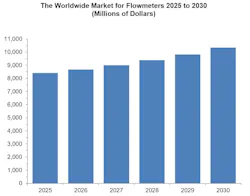
Despite economic uncertainties in 2025-26, the worldwide market for all types of flowmeters is expected to keep on increasing by more than 4% per year from revenues of $8.4 billion in 2025 to $10.4 billion in 2030, according to a new study, Volume X: the world market for flowmeters, 10th edition, published in September by Flow Research.
It adds that Coriolis and magnetic flowmeters will continue to generate the greatest share of the overall market’s revenue, while ultrasonic flowmeters are projected keep selling at the fastest rates. The study adds that ultrasonic flowmeters are heavily dependent on the oil and gas industry, which is one it’s projected to grow. In fact, the oil and gas industry, including refining, accounted for more than 50% of global ultrasonic flowmeter revenue in 2025.
Uncertainties identified by the study included tariffs, lower oil prices, slower drilling activity and postponed capital projects. They reduced demand for some flowmeter technologies during 2025. However, increasing natural gas production and expanding pipeline infrastructures fueled flowmeter demand in during the same period.
More specifically, oil prices have been higher because of reduced global supplies. This was largely due to disruptions in oil shipments through the Strait of Hormuz and via other Middle Eastern supply routes. At the same time, demand for natural gas pipeline capacity continues to grow, and is expected to increase further in 2027. Meanwhile, global LNG exports increased in 2025, even though supply disruptions affecting Middle Eastern LNG facilities reduced LNG trade in this year. Despite these disruptions, continued investment in new LNG facilities and natural gas pipeline infrastructure is creating opportunities for flowmeter suppliers.
“The worldwide flowmeter market is entering a new era of opportunity. Despite economic uncertainty in 2025-26, increased investment in natural gas infrastructure, LNG, water conservation and sustainable energy will create new opportunities for flowmeter suppliers,” explains Dr. Jesse Yoder, president and founder of Flow Research. “Coriolis and ultrasonic flowmeters are particularly well positioned to benefit from natural gas development and investment in sustainable energy, while magnetic flowmeters are gaining from the growing importance of water and wastewater measurement. With continuing technological improvements and the likelihood of a more favorable business climate, we see substantial opportunities for flowmeter growth through 2030.”
Yoder reports that results of this month’s U.S. midterm elections may produce more climate-friendly energy policies, including increased support for renewable and lower-emission energy sources such as natural gas. Environmental considerations will likely carry more weight with the new U.S. Congress starting in January 2027. While the Trump administration hasn’t been friendly to renewable energy, newly elected majorities in the U.S. Senate and House of Representatives are likely to encourage the long-term shifts away from coal and oil and towards natural gas and more sustainable energy sources.
Yoder adds that results of the U.S. midterms are also likely to reduce uncertainty for many businesses. While the war in Iran and recent tariffs disrupted decision-making, the latest election results will give companies in Europe and the U.S. more certainty about the future. For example, discussions in September with executives at flowmeter suppliers in Europe revealed that tariffs are contributing to uncertain business climates. At the same time, the Iran war has increased gasoline and diesel prices, contributing to inflation. The recent election results could lead to changes in tariff policy and U.S. foreign policy, potentially reducing uncertainties that affected industrial investments. However, the extent and timing of these changes remain to be determined.