Honeywell Cognition Edge brings intelligence to autonomous O&G ops
For all the investment in digital oilfield technology over the past two decades, onshore upstream production has remained stubbornly dependent on human intervention. Wells are manually monitored. On-site visits are needed to verify equipment downtime. Engineers must reconcile poor-quality data before they can make optimization decisions.
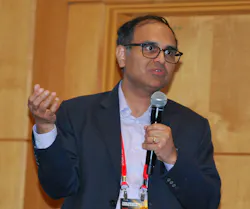
Honeywell Process Automation aims to flip the script with Cognition Edge, which moves advanced analytics, well optimization and autonomous control directly to the well pad, even when connectivity to central systems fails. During a session on the first day of Honeywell Users Group 2026 in Phoenix, Vineet Lasrado (pictured), global solutions lead for upstream and midstream at Honeywell, summed up the problem.
“Even with all the tools, there are still wells that may be manually monitored, or there could be slow reactions to abnormalities,” he said. “In many cases, when a well is down, the operator may not even know the well is down.”
Closing the connectivity gap
Connectivity is the root cause of much of the operational drag, Lasrado said. Many onshore fields have intermittent communications infrastructure, meaning that even when sophisticated analytics exist at the enterprise level, the data flowing in arrives late, incomplete or corrupted. Jaichander Sekaran, global offering leader for intelligent assets at Honeywell, who leads Cognition Edge’s technical development, sees hardware creating a new answer.
“The technology advances on the computing side have greatly advanced,” he said. “For a marginally higher cost, you can now have a high level of compute closer to the well pad. The question then becomes: How can we take advantage?"
Cognition Edge inserts an intelligent edge controller between the existing wellhead remote terminal unit (RTU) or controller and the supervisory control and data acquisition (SCADA) system without requiring a wholesale infrastructure replacement. It pulls real-time data from the wellhead, runs optimization locally, and sends control actions back to physical equipment. The result is adjusted choke valves, optimized gas and chemical injection rates based on live flow data rather than fixed schedules. Critically, it continues operating autonomously even when communications to the central SCADA or enterprise layer are lost, syncing its state once connectivity is restored.
Well testing to field optimization
Key use cases include autonomous well testing—automating stability checks and data validation to shorten test cycles and enable continuous rolling tests across an entire field. It also acts as a virtual flowmeter that delivers near-real-time oil, gas and water flow estimates without dedicated metering hardware on every well. “If you increase production across a field by even one or two percent, that translates into a huge number,” Sekaran said.
The platform also manages gas-lift allocation across well clusters and entire fields. When a compressor trips and available injection gas must be rationed, Cognition Edge determines in real-time which wells will yield the greatest production response. Chemical injection volumes are calculated dynamically against live flow rates, eliminating chronic overdosing.
Five pillars of the autonomous upstream
Lasrado framed Cognition Edge within a five-pillar vision for autonomous upstream operations. The first, “control and optimize,” covers artificial intelligence (AI) and advanced process control applied to sustain production—the domain where the platform lives.
The second, “intelligent assets,” targets predictive health monitoring of compressors, pumps, motors and rotating equipment, comparing actual performance against expected curves to catch degradation early.
The third, “expert people,” addresses the workforce dimension. Lasrado is emphatic that autonomy means augmentation, not replacement. “We’re not replacing the console operator. We’re making the console operator more efficient. We still need human-autonomy teaming.”
The fourth pillar, “integrated central operations,” recognizes that remote operations monitoring is not new to the industry, but that the quality of intelligence feeding centralized hubs is transforming. With agentic AI, Lasrado envisions agents connecting enterprise maintenance, production and energy applications in ways that deliver live information without manual orchestration.
The fifth pillar, “sustainability,” integrates emissions data, including AI-powered flare detection, into the same operational fabric. “A flaring event could be caused by a well going offline or a compressor winding down—it’s never one reason,” Lasrado said. “You need connected analytics and you need to think about how these systems interact.”
Guardrails and human override
In answer to questions from the audience about what happens when the system acts incorrectly, Sekaran said engineers define allowable operating envelopes—rate limits, valve positions, pressure thresholds—and the platform will not act outside them.
Repeated test failures trigger alerts to the control room. Override capabilities exist at every hierarchy level. “The system does not recommend—it acts,” Sekaran explained. “But we put checks and balances and limits in place. It won’t go outside the ranges the engineer has defined.”
Lasrado added a broader note of caution about the industry’s expectations for the autonomy journey itself. Having studied maturity models from automotive, heavy machinery and self-driving vehicle sectors, he said that full upstream autonomy is not a linear five-level progression.
“To reach full autonomy, you may need to progress across all dimensions simultaneously—control, asset intelligence, people capability, integrated operations and sustainability. And I don’t believe there’s a company today that has fully achieved that.”
For operators beginning the journey, Honeywell’s assertion is that the well pad is where it starts.
About the Author
 Len Vermillion