Making the case for a new era of operational value in chemicals
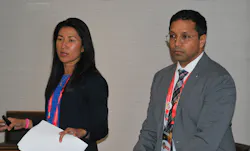
The chemicals industry has entered a new reality where the tailwinds that once fueled profitability have gone quiet, and where operational performance has become the principal lever for profitability. That was the message delivered at the 2026 Honeywell Users Group in Phoenix, where Honeywell’s Tiffany Barnes (left in image), global business director for diversified chemicals, and Omar Rhiman (right in image), business development director for Honeywell AutonomyX consulting practice, presented a framework for sustaining profitability in what they described as a structurally constrained market.
Barnes opened by laying out five compounding pressures reshaping the chemicals landscape—and made clear they are not cyclical blips but structural forces that will define the industry for years to come.
Production capacity has expanded faster than demand across several key value chains, particularly in regions that have seen aggressive investment in recent years. The result is a persistent supply glut driving sustained margin compression.
"The margin pressure is becoming a bit more persistent and not really temporary," Barnes said.
Layered on top are volatile energy and feedstock costs that, even when nominally stable, have become harder to predict—creating meaningful profitability differences between regions and forcing plants to operate with much tighter discipline around energy efficiency and feedstock utilization.
The challenges are compounded by aging infrastructure. Many facilities are running on legacy control systems simply not designed for the optimization, integration, or visibility demands of today's environment. "You really end up in situations where the data isn't always accessible," Barnes said. "Decisions heavily rely on experience, and we're seeing shift-to-shift performance variance."
Then there is the workforce dilemma. Experienced operators are retiring and taking with them deep institutional knowledge, while newer operators are being handed wider spans of control without the benefit of equivalent experience. Finally, sustainability and regulatory requirements, which were once the domain of compliance teams, have migrated directly into day-to-day operational decision-making, with emissions, energy intensity and efficiency now factoring into the choices made on the plant floor every hour.
A shift in how value is created
Barnes said the headwinds the chemical sector faces change the fundamental logic of value creation. "Historically, value came from increasing throughput, expanding capacity or adding new assets," she said. "But now a lot of the value is coming from consistency, better decision-making, and avoiding losses before they happen."
She explained that the question chemical producers are now asking isn’t "how do we produce more?" It’s "how do we run better and more consistently, every day?" The focus has shifted to asset availability and uptime.
This is also where digital and AI technologies take on a different role than in prior technology cycles. The risk, Barnes cautioned, is treating them the way earlier waves of digital transformation were treated—as separate tools or side projects where the return on investment was difficult to pin down.
"We really have to think about how decisions get made and executed, and shift from tools to embedded capabilities," she said.
Honeywell's outcome-driven approach
Omar Rhiman translated the market context into an operational methodology. The core of Honeywell's approach is a three-stage process built around financial outcomes rather than technology deployment for its own sake, he said.
The first stage is assessment: identify the biggest performance gaps and loss sources through direct engagement with the teams closest to the process. "Talking to the teams who are close to the problem is imperative," Rhiman said. "They're the ones who are going to give you the perspective you need."
The digital blueprint stage is a roadmap that identifies opportunities and ties them to business outcomes such as EBITDA, throughput, energy and reliability, instead of technology specifications. This stage ensures that what gets built connects to financial accountability.
Accelerated deployment proves value in a defined area, then scales it. Rhiman said the use-case-driven approach is more effective. "You're learning," he said. "In these multi-phase approaches with long life cycles, priorities are going to shift somewhere in between."
Honeywell AutonomyX steers the approach
The organizational vehicle for this work is Honeywell AutonomyX— a dedicated consulting group whose mandate, Rhiman explained, is to "design, execute, and govern complex, enterprise-wide operational transformation" tied to customer-specific KPIs.
What distinguishes Honeywell AutonomyX from conventional consulting is both operational depth and execution commitment. "We don't stop at gap identification and propose solutions. We execute and manage the projects for our clients to achieve the measured outcomes we agreed upon from the get-go."
The practice works across four enterprise pillars: AI and autonomy, digital reliability, cybersecurity and energy advisory, each mapped to one of the core challenges Barnes outlined.
New measure of success
The broader message from Barnes and Rhiman was that the chemicals industry is navigating a transition in what it means to succeed and, by extension, in what it means for technology providers to deliver value. Growth metrics are giving way to operational performance metrics. Capital expansion is being replaced by capital discipline. The industry is asking not for transformation blueprints, but for partners who can demonstrate tangible financial outcomes from the assets already in the ground.
About the Author
 Len Vermillion