A fighter's chin and a middle-reliever's mindset in building the data center ecosystem
Produced with support from Rockwell Automation
This show takeover was sponsored by our Automation Fair coverage partner, Rockwell Automation. See more coverage on our Automation Fair page.
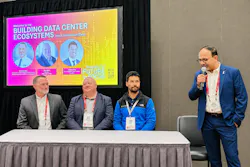
Need another indicator of how rapidly data centers are being built in the United States?
Three system integrators on a panel at Automation Fair 2026 described how they are booked solid for the next few years. Project after project after project. Their services are so in demand that they pick and choose which jobs they're willing to take on.
"At this point it's as much of us interviewing the data center owners than them interviewing us," said Dan Ryan, partner at BW Design Group, which specializes in mission critical data center system integration and controls. His fellow panelists—friendly competitors in this red-hot market—nodded in agreement.
At this moment in time, "mission critical" isn't an overstatement. The mission, of course, is building the facilities that empower the processing needed to meet our critical, insatiable need for AI.
Session moderator Anuj Mahendru, global industry director for semiconductor, data centers and high-tech at Rockwell Automation, welcomed the panelists to explore how collaboration across the data-center ecosystem, combined with automation and digital engineering, helps organizations and municipalities build and operate data centers more rapidly, more efficiently and with greater resilience and complexity.
Take a punch
"Modern control systems must be able to take a punch and survive," said panelist Chad Deviller, data center division manager for Prime Controls, who added an example of a massive liquid-cooled data center needing to be able to absorb environmental fluctuations relying on predictive (rather than reactive) control systems in a multi-unit campus.
Similarly, on the human front, the panelists noted how data-center advocates must often have a fighter's chin in dealing with objections to the emerging facilities. They cite poor communications and insufficient education on behalf of the data center industry as the cause of much of this public outcry, and are proud to note that they are correcting the narrative. "We have not done a good job explaining what we do," admitted Ryan, noting that this is changing for the better with greater public understanding of the reality of data centers and informative events like this panel.
Middle relievers
Addressing that data-center complexity issue, Ryan explained the evolution of these types of computing facilities—what used to be traditional HVAC control setups has grown into complete-building automation systems layered atop complex electric monitoring systems with demands for hardcore redundancy, zero downtime, and the ability to communicate over dozens of communication platforms.
"It requires a higher level of system integrator," summarized Ryan, less boasting than stating a fact.
And it requires earlier involvement in the projects by system integrators, if they are to be done properly.
"This industry is coming to the realization that the control system is as important as the other elements," surmised panelist Jason King, vice president of data centers at RoviSys. "We are starting to be brought into the data-center-building process earlier. Day one would be best. I'd like to be involved with the architects who start working."
That participation of the system integrators mitigates wasted time and money and effort, as with the project King referenced in which an asset was erroneously installed on a data center roof that could not support it. A savvy system integrator would have spotted that mistake during the planning stages and hit the brakes.
Deviller likened the data center system integrator to a baseball pitcher historically relegated to the reliever role (coming into play near the end of the process). "But with the speed to market of data centers these days and with clients asking more and more of us, we're actually like middle relievers, informing the construction approach of the entire campus."
In short, there is a greater appreciation among those funding data-center projects of the critical role that system integrators play. "In the past there was some hesitation, some belief that we were selling them things they don't need," said King. "That mindset has changed. They now understand the value we bring."
That value entails partnering with hyperscalers; working with Google and Amazon to deliver advanced programs; bringing into reality massive, 900-megawatt facilities in record time employing modular systems with as many assets manufactured offsite as possible.
Furthermore, the modern system integrator working on data-center projects is empowered by strong partnerships with solution providers like Rockwell Automation. "This is truly a partner-led approach," said Mahendru, referencing the work histories he and Rockwell have with these panelists' firms.
Added Deviller, "With Rockwell we are partnered with an industry leader. That's an easy sell to data-center owners. We have a history of meeting their needs with these industrial products. And the Rockwell supply chain is able to navigate this whole process."
Closer
It's a complicated process. Demand shows no sign of waning. And that enthusiasm among those funding the build of data centers is matched by those teams doing the work.
"This is an exciting space," said Rockwell's Mahendru, underselling the hottest building craze in decades.
And without a hint of bravado, the system integrators explained how the market—this exciting space—is finally catching up to what they do well...PLCs and complex networks and smart hardware that can deliver massive amounts of data in templatized, standardized ways. In other words, advanced controls for the automation of what they colloquially call "AI factories."