Rockwell Automation’s Moret makes a case for AI that simplifies, not complicates
Produced with support from Rockwell Automation
This show takeover was sponsored by our Automation Fair coverage partner, Rockwell Automation. See more coverage on our Automation Fair page.
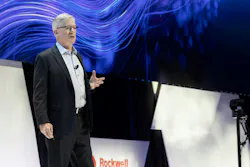
Rockwell Automation Chairman and CEO Blake Moret took the keynote stage at Automation Fair and told attendees that the long-running conference matters because, simply put, manufacturing matters. He then laid out how the company and its partners plan to use artificial intelligence (AI) to cut the complexity that now burdens industrial operations.
Moret, who has attended most editions of the event, said this year’s Automation Fair, held in Boston’s Seaport District, would be unlike any the company has held. He noted that it is more than a product showcase. It also offers hands-on labs, training sessions and curated discussions aimed at helping customers succeed with the technology.
Why the work matters
Moret framed the week in terms of what manufacturing delivers. Food packaged for preservation, and medicines that help people live healthier lives. Abundant energy and transportation are all impossible without manufacturing, he said, and manufacturing is impossible without automation. The past few years, he added, have shown how much society depends on manufacturers.
The challenge for industry, he continued, is managing many simultaneous priorities inside plants while also absorbing a growing load of external complexity. Moret called the biggest challenge and the biggest opportunity the same thing: simplifying that complexity. Manufacturers still need resilience, agility and sustainability, but they must achieve them in a way that lets operators interact with technology more easily and run systems that perform better with less downtime.
AI is central to that outcome. He described simplifying complexity as the single biggest opportunity AI offers industrial users, and he said it should be built into control systems.
Its own proving ground
Moret reminded the audience that Rockwell Automation is primarily a manufacturer, and said its own plants are where it tests technologies before offering them to customers. He cited a Rockwell facility in Singapore recognized by the World Economic Forum and beamed about its significant gains in productivity and sustainability using Rockwell Automation’s own technology.
He also pointed to the company’s next project as its most ambitious. The company is planning a new facility in New Berlin, Wisc., which Moret described as its most advanced and largest plant, with construction due to start early next year.
A vision of autonomous operations
“Our vision is to create the future of industrial operations,” Moret said. He described equipment that operates autonomously and integrates seamlessly into a highly orchestrated production system, one that can anticipate needs and keep learning from its data. The payoff comes from freeing people from routine tasks so they can focus on creativity and innovation.
Simulation models and digital twins will become more important to that picture, he added, because they let companies test and optimize before changes reach the plant floor. Whatever the technology, the goal is optimizing production.
Customer examples: BHP and Angelini
Moret used two customers at opposite ends of the market to show what this future can look like in practice.
The first was mining giant BHP. Rockwell Automation and BHP worked together on a vision for a step change in productivity, one that lets BHP make decisions across its entire span of operations, from mining through processing, and optimize continuously across those areas. Moret said the convergence of IT and OT puts Rockwell Automation in a vital role in such a project, noting that the company intends to help BHP’s operations become increasingly autonomous over time. Rockwell Automation combines its understanding of controls and the physical process with its customers’ domain expertise, which he argued still matters in the age of AI, according to Moret.
At the other end of the spectrum, Angelini Technologies, a machine builder, has standardized simulation and digital twins for developing and testing its machines. Moret said the COVID-19 shutdowns highlighted how valuable it is to be able to test and commission machines—virtually—when people cannot be on site.
AI-assisted design and the NVIDIA tie-in
Moret added that Rockwell Automation’s design software is where AI is changing the most. He described a new capability that lets engineers start with a natural-language description of a task. AI agents then generate the control logic and related information flows, which he said could overhaul how automation projects are built. Machine builders, including Angelini, are excited about it.
Moret added the work includes integrations with NVIDIA’s open-weight AI models and the ability to run AI agents locally, which he said can avoid the per-token costs of cloud-based models. That approach also keeps control of operational data and AI spending in the customer’s hands, he said, and applies across the project lifecycle.
That local-AI approach was backed by a hardware announcement issued the same day. Rockwell Automation unveiled new GPU-enabled industrial PCs built on NVIDIA accelerated computing. The initial offering includes the 6300B-SB1 EdgeAI 4000, with an NVIDIA RTX PRO 4000 Blackwell GPU, and the 6300B-SB1 EdgeAI 2000, with an NVIDIA RTX 2000E Ada Generation GPU.
The machines add processing capacity at the supervisory layer for demanding workloads such as advanced machine vision, model predictive control, predictive maintenance and small language models that give operators real-time advisory support. The models can run on premises and integrate with Rockwell Automation’s FactoryTalk Optix HMI and visualization software, giving low-latency guidance where cloud connectivity is limited or data must stay inside the facility.
The new PCs complement (rather than replace) Rockwell’s existing control, HMI and edge architectures, many of which already support AI without discrete GPUs.
Connected workers
Moret also noted how Rockwell Automation is extending opportunities in mobility. The company is combining the fleet management and flexibility of its mobile robots with the strengths of traditional fixed automation, he said, and tying that into connected-worker strategies.
He closed by calling Automation Fair a celebration of Rockwell and its partners, adding that the show floor actively demonstrates how the company is bringing that future in focus.
About the Author
 Len Vermillion