Shocking the past, trusting the future: A keynote from Rockwell Automation’s SVP
Produced with support from Rockwell Automation
This show takeover was sponsored by our Automation Fair coverage partner, Rockwell Automation. See more coverage on our Automation Fair page.
What’s so great about standing on the shoulders of giants?
The better, more elevated and wider view, of course, but it’s mainly about boosting new efforts with the hard-won experience, insights and established capabilities gained from previous projects. The same goes for artificial intelligence (AI) and much-desired autonomous operations, which are widely sought after, but can only succeed if they augment and build on the decades of automation know-how that went before, and the efficiencies, optimization and savings they achieved.
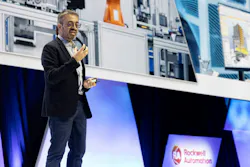
“Physical AI can potentially provide more insights, but if it doesn’t give users information they can act on, then it’s just moving the same bottlenecks to another location,” said Cyril Perducat, senior vice president and chief technical officer at Rockwell Automation, who presented his keynote address at Automation Fair 2026 in Boston. “Because of our experience, only Rockwell can empower users to scale their manufacturing operations and production systems to unlock these new performance levels.”
Beyond its tenure and widespread coverage, what makes it possible for automation to provide a foundation that AI and autonomy can build on? Trust. Not the regular, innocent or leap-of-faith types, but time-tested trust based on working with solutions, such as Rockwell’s automation hardware, software and other products that have already served industries consistently and reliably for many years.
“This kind of proven trust in systems is a mindset,” explained Perducat. “However, users must also be willing to reinvent themselves when necessary because future problems often require new and sometimes unfamiliar solutions. Understanding today’s technologies and the solutions they require sometimes means shocking the past so we can go there.”
Whether they’re fueled by digitalization’s latest technological upheavals, or eternal demands to do more with less, Perducat reports that Rockwell’s many diverse customers worldwide share common needs for faster production, safety and security. However, they’d doubtless appreciate the chance to streamline some tasks, settle their nerves, save some time and labor; and gain some peace of mind by being confident in the solutions, software and system they implement.
“This is a primary motivation for moving from automation to autonomous operations. To make it happen, we have to hide some of its complexity behind a great user experience, be consistent with each user’s workflows, let them reinvent themselves and their applications, and bring in the human dimension that can enable collaboration,” added Perducat. “Automation and autonomy aren’t mutually exclusive. They can support each other, and AI agents and autonomy can even augment automation. Embracing news technologies is in Rockwell’s DNA, and autonomy just another example of it.”
So how can users employ AI agents and agentic systems to unlock new production capabilities while improving performance? Perducat reported that autonomy can also be thought of as adding AI capabilities to existing automation and using it to identify opportunities for optimization in otherwise hopelessly complex situations. Or at least finding improvements in places where people don’t have time to look and/or within data they don’t have time to analyze.
“To better assist humans, AI needs to include learnings from them,” said Perducat. “For instance, users who understand what they want their operations to do can help teach AI agents what they need to know and extend the value of existing operations. This is where every user’s industrial skills can come in to augment AI agents. Autonomy is often thought of as being on autopilot, but it’s actually more focused on using many of the unique aspects of human intelligence, and enabling other systems and users to take advantage of them, too. In short, autonomy is automation augmented with reasoning and learning.”
Perducat reported that autonomy enhanced by automation can provide benefits in several crucial applications, including:
- Insights can be increased by taking information that needs to be analyzed, and applying AI agents to generate analyses in real time
- More data can be created and stored, and this can create a circle of continuous learning
- Transformations of plant-floor applications that can migrate from formerly unavoidable rip-and-replace projects to instead building on legacy environments
“This means less frequent replacements, more building on existing layers, and further extending their lifecycles,” explained Perducat. “In the same way that contextualizing data results in more effective actions, AI and autonomy can add a new dimension of learning to existing production and control loops. And then, using tools like Rockwell’s FactoryTalk Conductor, our newly expanded and contextualized knowledge can be shared with more users, so fewer of them have to start from scratch on similar tasks and projects.”
Perducat concluded that, just as Rockwell is seeking to extend the navigation techniques of autonomous mobile robots (AMR) to larger production lines, it also wants to use similar strategies to help people evolve their roles in operations.
“We want users to free their minds and be able to strategize about larger issues and solutions,” he said. “We think the missing piece here is autonomy augmented by automation. This is the future that Rockwell wants to enable.”
About the Author
 Jim Montague