Lofty dreams grounded in basics: biopharma leaders say AI ambitions hinge on getting data right
Produced with support from Rockwell Automation
This show takeover was sponsored by our Automation Fair coverage partner, Rockwell Automation. See more coverage on our Automation Fair page.
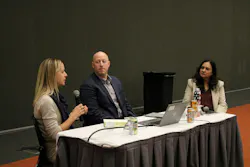
As drugmakers race to diversify their pipelines and speed therapies to patients, the executives helping them build factories say the industry’s biggest obstacle is not a lack of artificial intelligence. It is a lack of clean, contextualized data.
That was the message from two industry leaders at a press conference during Automation Fair 2026 in Boston: Ashley Howard, senior director of automation and digital product management at Cytiva, and Ryan Nielsen, director of global life sciences at Rockwell Automation.
Biopharma manufacturing is changing as companies look to broaden their pipelines, shorten development timelines and build more flexible operations. That is driving demand for connected, flexible, scalable and intelligent operations.
Same old problem
Asked about customer challenges, Howard said the industry’s core difficulty has not changed. “The problems that have been around forever still persist,” she explained. That means “a good, robust, reliable architecture to get your equipment data, your process data and your batch context off of your equipment.”
Howard added that the industry is under pressure to apply AI to everything, but that pressure doesn’t remove the need for fundamentals. Without process context and an open architecture, she said, the problem “is not going to be solved by adding AI on top.”
Customers want to know how they can move faster and accelerate therapeutics, Howard said. To do that, they need access to information and an architecture that works with them, so they can collect data, make better decisions and bring new, complex modalities to patients more rapidly.
Nielsen agreed. “Transforming data into information is critical, and it has been a difficulty with the industry for a very long time,” he explained. “It’s not a new problem.”
Whatever the type of therapy, he continued, the goal is the same. Manufacturers want a return on their investment, and they want patients to receive medicines sooner.
Matching automation to the customer
Cytiva, which builds bioprocessing equipment, and Rockwell Automation have partnered for years. Howard described Cytiva as a “North Star” partner, working together on a global scale from the equipment and input/output layer up to the technology layered on top of it.
That scale means accommodating very different customers, she said. Some face intense price and speed competition, as in China. Others have distinct regional needs, as in India. “We need to meet our customers where they are,” Howard said.
Budget and development stage matter too, she said. A global top 25 pharmaceutical company has different resources and production needs than an emerging biotech.
“We need to consider the budget. We need to consider what stage they’re in,” Howard added, adding that an early-stage company needs flexibility and cost-effective tools, and “it doesn’t make sense to have a large DCS installed in the earlier stages,” referring to a distributed-control system, the large process-control platforms common in commercial plants.
The two companies partnered last year on a low-barrier, modular approach to automating multiple unit operations, Howard said. It is meant to support development of newer, complex therapies. She cited antibody-drug conjugate (ADC) manufacturing as an example. The process is hazardous, so automation that keeps operators off the shop floor carries real value.
Nielsen pointed to the scale of Rockwell Automation’s life-sciences ecosystem, saying the company works with more than 500 life sciences partners. Bringing equipment builders and end users together in one room helps the industry clarify what it is trying to achieve and what challenges it faces. “Everyone wins,” he said.
Plug-and-play and digital twins
Both executives highlighted technologies that cut the time and cost of getting equipment running. Nielsen said edge technology can shrink the physical footprint of control hardware and help set up digitally enabled plants. He also cited digital twins—those virtual models of equipment and processes that can reduce time spent on validation testing, commissioning and training.
Both companies support the module type package (MTP) standard, which Nielsen likened to connecting a phone. “You plug it in, sometimes you pair it a little, but it just works,” he said. Rockwell Automation is using MTP, he added, to make its automation platform more open and to support customers who ask for plug-and-play integration.
A human in the loop
The discussion turned to autonomous operations, a theme of the Automation Fair keynote. The moderator noted that life sciences are heavily regulated and that customers sit at very different points on their digital journeys, though most are moving from siloed systems toward connected and, eventually, more intelligent operations.
Nielsen said aspirational goals, such as a fully “lights-out” facility, are worth setting even if the technology isn’t there yet. But he said companies also need to know where they stand today. Rockwell Automation and its partners offer digital-maturity assessments to map the steps in between. Most companies, he said, won’t be able to leap straight to the end state.
Regulation reinforces that caution, he said. Life sciences are among the rare industries that can’t afford to take shortcuts, because its products are life-saving therapies and medical devices, and manufacturers must stay compliant while taking a measured approach.
Howard said she expects people to remain part of the process. “I think we’re going to have a human in the loop for the foreseeable future,” she opined, in part because of the regulated setting and in part because operators bring “incredible value” to the shop floor.
But the shop floor is changing. Newer workers are used to having technology in their hands, including AI tools, and the industry faces a wave of retirements. Equipment will need to be easier to use, Howard said, and manufacturers must be ready for “that new paradigm of operations.”
The path starts with the basics, she said: storing data, putting it in context, and then applying AI across equipment, process and batch information. That can generate insights that help manufacturers run more productive processes with less variation.
Nielsen pointed to Rockwell Automation’s FactoryTalk Optix as one way to capture equipment data and operator-interface information. He also described an emerging agentic approach in which a large-language model acts as a conductor, directing different AI agents through an MCP (Model Context Protocol) server. Those capabilities, he said, are something the industry will build toward, with “incremental benefits” along the way.
About the Author
 Len Vermillion