Why industrial AI adoption stalls and how to unstick it
Produced with support from Yokogawa
This show takeover was sponsored by our YNOW2026 coverage partner, Yokogawa. See more coverage on our YNOW2026 page.
The pitch for artificial intelligence (AI) in process control has never been the problem. Aging workforces, volatile markets and increasingly complex operations have made the case for smarter plants for years.
What's harder to explain is why so many promising AI pilots quietly die on the way to the plant floor.
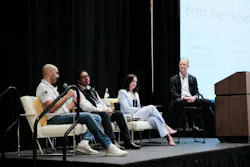
At YNOW2026, Yokogawa's Flagship Users Conference & Exhibition, in New Orleans, a panel of industry experts addressed that very question. The session From Industry Pain Points to AI Breakthroughs: How Emerging Companies Are Shaping the Future of Industrial Operations brought together Elbert van der Bijl, Director of Organization Transformation, Solutions Consulting & IT at Yokogawa Corporation of America, as moderator; Carolina Rio, Director of Plug and Play Tech Center in Houston, Texas; Vikram Jayaram, Founder and CEO of Neuralix; and Omar Talib, Co-Founder and President of ControlRoom.ai.
Van der Bijl framed the discussion by pondering why ideas move from academia to startups to owner-operators every day, yet many stall out in what he called "proved concept, proved value." The problem: they never quite make the leap to scaled, everyday use.
"Why aren't we able, as an industry, to move these great ideas and technology developments forward that can lead to bigger adoption?" he asked the conference attendees.
To make his point, he live-polled the conference attendees for the words they most associate with barriers to adoption. The answers that most popped up on a screen were “fear, trust and context,” which all became a running thread for the rest of the session.
Real opportunity, real pain
None of the panelists disputed that the upside of AI adoption is enormous. Van der Bijl pointed to a workforce retirement wave that COVID-19 accelerated, a generation of new operators with different expectations for where and how they work, and a geopolitically unstable world piling pressure onto plant performance. Layer on the openness created by affordable, off-the-shelf digital infrastructure like the shift Windows brought to enterprise IT a generation ago, and the conditions for AI-driven transformation are more favorable than ever, he said.
Talib, whose company ControlRoom.ai builds an "agentic troubleshooting" suite for continuous operations, agreed the moment has genuinely shifted. Despite four years of hard-won lessons since the company's 2021 founding, he told the audience he believes something fundamentally changed in the industry in just the last few months, and that progress is now compounding "faster, faster, faster."
Scaling: where good ideas go to die
Scaling is where the panel spent most of its time. It’s also where the statistics got sobering.
Rio, who works at the intersection of corporates and startups through Plug and Play's global innovation network, put a number on what the industry calls "pilot purgatory" saying only around 30% of proofs-of-concept make it to scaled deployment. She cited research suggesting roughly 90% of companies are now attempting to use AI, with a large share chasing revenue gains from it, yet only about 20% succeed at scale.
Startups aren't immune to that same gravity; a Kansas State University study found 54% of AI startups fail to scale and simply disappear, while only 22% scale successfully on their own. The rest get absorbed through acquisition.
For Jayaram, the scaling failure is rarely about the algorithm itself. Bigger data sets and bigger compute, he argued, "does not automatically create value." The limiting factor isn't the data coming in, but whether the processes around it are aligned to use it. Domain knowledge is what outsiders underestimate. Companies that arrive without a deep understanding of an industry's nuances find it extremely difficult to scale within it.
Five statements, one debate
Van der Bijl opened the session with five statements designed to deliberately spark disagreement. Several drew direct responses. Example: "Industrial AI has an adoption problem, not a technology problem."
Jayaram added that industrial AI should start with the operational problem, not the AI itself. Companies that lead with technology rather than a clearly defined business problem are the ones that stall.
"A successful pilot proves almost nothing about the ability to scale," Rio added, calling it less a question than an established truth. A pilot can prove a technology works, she said, but scaling it "is a completely different world" and that’s why Plug and Play built infrastructure across 65 global locations and backed more than 140 companies in manufacturing technology and 150 in simulation tools, specifically to help close that gap.
"The biggest barrier to industrial AI is not cybersecurity or technology, it's organizational ownership," Van der Bijl continued. His opening poll captured these barriers that are organizational and cultural more than technical: fear of AI intervening in a critical operation, and a basic lack of trust in a system operators didn't build.
His third statement, "Startups need large industrial companies more than large industrial companies need startups," elicited more stats and facts from the panelists. Rio made the numerical case, pointing to the 22% solo-success rate as evidence the relationship is more asymmetric than founders like to admit.
"Within five years, industrial companies will expect AI capabilities to be embedded in their automation environment, not purchased as a standalone application," Van der Bijl said. No panelist rejected his statement, and Jayaram went on to add that buyers must change their AI-purchasing habits to be pointed the same way. The software-development lifecycle has been "turned upside down," he said, adding that since generative AI arrived, the line has been blurred between what used to be discrete engineering disciplines and, by extension, between an AI product and the automation platform itself.
Operational focus, theoretical value
If there was a unifying lesson from the panel, it came from Talib's three rules for startups: focus relentlessly on operations, because operations groups keep the plant running and pay for everything else; deliver real, hard-dollar value fast rather than theoretical savings; and be "present"—solving the problem happening in the next five minutes, not a hypothetical one three months out. The culture in an operational setting rewards the team that shows up for today's crisis, he said, not the one promising to prevent tomorrow's.
Supplying expertise and trust
Running through the session was an implicit case for Yokogawa's own role as the connective tissue the industry is missing. As moderator, Van der Bijl positioned the automation major not as a competitor to startups like Neuralix and ControlRoom.ai, but as the owner-operator-facing platform that can carry proven innovation the last mile. A company such as Yokogawa can supply the domain expertise, operational trust and embedded automation environment that Jayaram argued industrial AI increasingly needs to live inside of, rather than beside.
The panel didn't claim to have solved industrial AI's adoption gap. But it left the stage with a clearer diagnosis: the technology is largely ready. What the industry still needs to build is the organizational muscle, the buying models, and the trusted infrastructure to let it scale.
About the Author
 Len Vermillion