Driving through the automotive factory knowledge roadblocks
Produced with support from Rockwell Automation
This show takeover was sponsored by our Automation Fair coverage partner, Rockwell Automation. See more coverage on our Automation Fair page.
For automotive manufacturers, keeping the line moving has never been more complicated. A single facility may need to build internal-combustion vehicles, hybrids and battery-electric models on the same line. Supply chains remain exposed to geopolitical disruptions, while tariffs and shifting trade policies continue to influence sourcing and production decisions. Inside the plant, software, automation and connected systems are spreading across operations as experienced workers approach retirement.
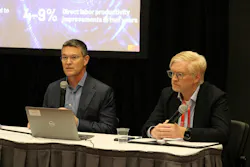
At a press conference during Automation Fair 2026 in Boston, James Glasson, Rockwell Automation vice president of global industry, auto, tire & advanced mobility, detailed these mounting pressures. Joined by Edgar Faler, principal, industry and strategy at the Center for Automotive Research, the pair discussed findings from the recent white paper Smart Manufacturing in Automotive: Deployment and Impact.
Start your engines
“When we think about pain points of what's happening in automotive, we think about the compression of complexity,” Glasson said. Production teams must keep engineering, with procurement and supply chains in lockstep, all while reacting immediately to design or demand changes. That requires elevating scattered data from isolated platforms into clear, usable information for daily decision-making.
As Glasson explained, the priority is moving toward real-time, intelligent operations by connecting “the entirety of the system to drive insights and analytics,” rather than simply linking disparate software.
In automotive plants, gaps in production information can have consequences several stages down the line. A vehicle arriving at final assembly may have a different combination of trim, color, options and powertrain than the one ahead of it. Production systems must accommodate those variations without sacrificing process control or traceability. “The complexity of the manufacturing environment is so dynamic and it’s complex,” noted Glasson.
He pointed to a body-shop example in which a dimensional error introduced earlier in production may not appear until a door fails to fit during final assembly. By then, several vehicles may have moved through the same process with the same defect. “We don’t want to talk about individual silos of data,” he said.
That logic carries into one of the most energy-intensive areas of an automotive plant: the paint shop. A useful test case for connected analytics, the paint shop’s ventilation, air-handling and process equipment place substantial demands on energy, while the number of motors and drives creates opportunities to monitor performance. “There are 500 to 600 drives in an individual paint system,” Glasson said.
Tracking those drives, motors and supporting systems in real time can help identify inefficiencies before they become costly problems. Glasson pointed to compressed-air systems as one example. Leaks can keep compressors running unnecessarily, increasing energy consumption without contributing to production. Detecting them early gives maintenance teams an opportunity to correct the problem and reduce waste.
Turning operational knowledge into usable information
Of course, any shift toward automation and data brings manufacturers right back to their perennial talent crunch. Rockwell Automation's 11th Annual State of Smart Manufacturing Report, based on responses from 1,560 manufacturing decision-makers across 17 countries, identifies workforce-related pressures, including skills shortages and rising labour costs, among the challenges facing manufacturers. The study found that an average of 28% of operating budgets is dedicated to industrial technology. It also reported that 40% of organizations had reskilled their workforces during the previous year.
The findings reflect an industry training employees to work with sophisticated systems while trying to preserve the expertise of experienced personnel. Glasson described how AI could help make that knowledge more accessible. Maintenance records, repair logs and troubleshooting histories can provide context when technicians encounter recurring faults. “So, we do things like using fixed-language models to data mine through artificial intelligence the repair logs to then create insights as to 80% of the time what's going to fix that error code,” he said.
As experienced workers leave and new technicians enter the plant, manufacturers need ways to transfer practical knowledge more quickly. “We tie it back to the opportunities for labor,” Glasson explained. “Think about bringing new labor into the manufacturing environment. They might not be skilled in maintaining that equipment or that manufacturing line, but we need to make their time to efficiency immediately impactful. We can't wait six months for them to learn the process.”
One application involves using AI to search maintenance records and make experienced workers’ troubleshooting knowledge available to less-experienced technicians. Newbies now access the same information that the person that’s been doing the job for 10 years knows, and they can do it the first day they’re on the job.
If the goal is to shorten the path between a problem and a likely solution, a less-experienced technician can draw on the accumulated experience of previous repairs rather than relying solely on the availability of a veteran colleague. The overall value is making existing expertise easier to retrieve and apply. But the approach still requires engineering judgment; and recommendations must be evaluated against the machine and the specifics of the fault. The quality of any output also depends on the quality of the underlying data.
AI orchestration and trust
Rockwell Automation is also developing software intended to connect AI capabilities across engineering workflows. At Automation Fair 2026, the company previewed FactoryTalk Conductor, an AI-native orchestration platform designed to coordinate AI agents, skills, workflows and automation software across design, simulation and testing activities. Initial integrations are planned for Studio 5000 Logix Designer, Logix Echo, Emulate3D and FactoryTalk Optix. FactoryTalk Conductor is expected to become commercially available in the first quarter of 2027.
Making expertise reusable across facilities raises another question: How can manufacturers ensure AI-generated recommendations reflect consistent processes and standards across their operations?
Glasson emphasized the importance of standardization. “You don't want to create, say, a body shop for one manufacturer’s plant, and then they have unique body shops in every other facility,” he said. The idea is to carry validated practices, process requirements and engineering standards from one facility to another. Reusing that knowledge enables manufacturers to build on existing solutions rather than repeatedly developing new ones for the same operational challenges.
Keeping operational knowledge within the company’s control is another part of building trust in AI. Manufacturers are often reluctant to expose engineering files, production records and operational information outside their own environments. “While you’re leveraging skills, the work that you’re providing, the output that you’re creating stays within your own walls,” Glasson said.
Modernizing without starting over
The discussion also touched on autonomous operations and the relationship between vehicles and factory automation. Glasson pointed to Tesla vehicles moving themselves through portions of assembly and logistics operations. "The vehicle itself has to integrate with the safety-control systems of the plant in order to do that," he said.
Manufacturing facilities often contain equipment, control systems and industrial networks installed over decades. Replacing those assets wholesale is rarely practical, particularly when major upgrades must fit into short summer or holiday shutdown periods. “You really can’t rip and replace the entire manufacturing environment,” Glasson said.
That reality also shapes how manufacturers approach digital transformation. New analytics and AI applications must work alongside existing equipment and systems, accommodating the infrastructure already in place.
The presentation ultimately returned to the value of experience on the plant floor. Long before generative AI entered the picture, manufacturers depended on the judgment of engineers, technicians and operators who understood how equipment performed and how processes behaved under real-world conditions.
The opportunity for AI lies partly in capturing that accumulated knowledge and making it accessible through maintenance histories, engineering decisions, process standards and the practical lessons of experienced workers. Making this information available is an important step, but it does not remove the need for people who can interpret results, assess recommendations and understand the consequences of a decision.
To put it bluntly, AI may speed up the process; sound engineering judgment will remain essential to getting it right.