Goals (with guardrails): evolving AI and AI governance
Produced with support from Rockwell Automation
This show takeover was sponsored by our Automation Fair coverage partner, Rockwell Automation. See more coverage on our Automation Fair page.
We're all enamored with the capabilities of artificial intelligence. Nowhere is this more true than in the manufacturing space, where AI-empowered optimizations dazzle and delight decision makers. But we're all simultaneously wary of AI, to varying degrees, recognizing potential dangers and disappointments with this new tool. This is also particularly true among manufacturers.
That's where proper governance comes into play. Guardrails, if you will.
But with a tool as dynamic and rapidly evolving at AI, time-tested governance approaches might not always work. Can we erect guardrails on a road that is building itself at 100 miles an hour?
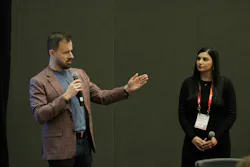
Two thought-leaders tackled that question during Automation Fair 2026. Allie Farley, Rockwell Automation director of co-innovation, and Ryan Gariepy, vice president of Frontier Labs, Rockwell Automation, presented "Managing Industrial AI Governance" to a crowd eager to listen, learn and pose questions about adopting smart, safe strategies for AI in the industrial arena.
The duo kicked things off by addressing a sea change in processes. "AI is now using our products, rather than our products having AI in them," Gariepy explained, referencing Rockwell Automation's Plex MES and even AMRs as examples. What he means is this—AI agents leveraging large-language models to automate workflows within automated systems. Heady stuff, for sure, stuff that was historically handed by humans. "Think of it as AI agents acting as conductors of an orchestra."
Farley pulled up a graphic that detailed a traditional, typical process paradigm, with a human directly operating a product. The next graphic displayed the evolving, AI-empowered approach, in which AI agents act on the human user's behalf to determine the best use of a product toward the specific goal, then connect with a user interface to engage with a product to deliver the desired outcome. This is AI agents leveraging Rockwell Automation products as tools in their toolbox, she said, noting that in the coming decade, half of the "users" of Rockwell Automation solutions will be AI agents.
"And that's shifting how we think about our portfolios," she said. "How we make our software and hardware agent-ready to enable them to fully engage."
The Frontier Labs group in which Gariepy works is actively propelling that portfolio evolution, constantly experimenting with new methods within existing governance guidelines to use agentic AI for industrial production. Critical, he stressed, is maintaining a system-wide mindset; rather than trying to make every machine as intelligent as possible, considering how to optimize larger systems to achieve these lofty AI goals.
And that carries over into the personnel that will continue to work alongside and within these autonomous programs. The men and women in the orchestra, to continue that metaphor. Gariepy proposed that a deep understanding of how tasks are performed (by humans) informs the best strategies to have that work augmented by agents. "The AI agent is not a replacement for a skilled worker," he clarified, echoing a sentiment heard throughout presentations and conversations this week.
Governance guardrails
The duo then dove deeper into AI governance, particularly how nimble and adaptive teams must be to align proper governance policies to the AI approach / tool / technique that seems to reinvent itself constantly.
Helpful, said Gariepy, is that AI is informed by legacy data and existing Rockwell Automation tools that have been in use (and trusted) for decades. Same goes for that wealth of human knowledge that guides and informs these systems.
He referenced FactoryTalk Conductor, Rockwell Automation’s AI‑native orchestration platform that coordinates AI agents, workflows, and industrial expertise across the automation lifecycle, slated for release in early 2027. Not a magical wizard that runs the factory, he explained, but rather a governance and security layer that can be built into industrial processes to ensure adherence to standards across an enterprise. “A straightforward way to ensure governance,” he called it.
Farley added how her team aligns with internal bodies such as the Rockwell Automation AI Governance Council to constantly review policies and practices in order to fully comply with internal and external guidelines.
"Governance is happening across the industrial stack—at the edge, within MES, etc." said Farley, before adding a comment that is applicable to both artificial intelligence itself and the policies and practices required to properly govern its use.
"This is an evolving topic....and it is evolving quickly."