FactoryTalk Conductor puts AI agents to work across the plant
Produced with support from Rockwell Automation
This show takeover was sponsored by our Automation Fair coverage partner, Rockwell Automation. See more coverage on our Automation Fair page.
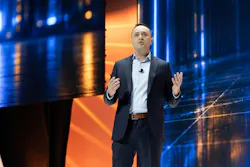
Rockwell Automation recently introduced FactoryTalk Conductor, which it calls its industrial agent platform, and attendees of Automation Fair 2026 in Boston got a detailed look at its capabilities. The platform is designed to let artificial intelligence (AI) agents operate Rockwell Automation’s software and hardware the way human engineers, operators and technicians do.
Jordan Reynolds, senior vice president of lifecycle services, kicked off the third day of the event with a keynote address examining the platform. He framed its development as a response to rising complexity in manufacturing and a shrinking labor pool.
“Automation is incredibly complex,” Reynolds told the audience, noting the routine work engineers endure, such as building simulation environments, programming and emulating PLCs, building HMIs, mapping I/O, discovering devices on the network, tracking firmware versions and interacting with MES and other platforms. Plants must also work with the equipment already on the floor, he continued, including many devices and protocols, some of which have run for decades.
Replacing everything is rarely an option.
A widening labor gap
Reynolds cited a projected global manufacturing-labor shortfall of about four million workers by the end of the decade, roughly two million of them in the United States. Customers, he said, are asking for decreased complexity and the ability to do more with less.
“The opportunity to turn days into hours and hours into minutes” is what emerging AI technologies offer, Reynolds said, pitching FactoryTalk Conductor to unlock new levels of productivity, efficiency and innovation.
An industry inversion
Reynolds argued that industrial AI is undergoing a rapid change. Industrial AI once meant products such as quality systems, MES platforms or maintenance tools that used AI features, like vision systems or anomaly detection, to work better. “It’s not as much about products that use AI anymore,” Reynolds explained. “It’s more about AI that uses products.”
Generative AI systems, he said, can reason about the steps needed for a task, explore alternative courses of action, evaluate the simulated outcome of each, choose the best and repeat the process in a closed loop. In practice, he said, agents can draft functional specifications, design and run simulations, write PLC code, and configure HMIs and drives.
That shift, Reynolds said, changes product strategy for vendors. “Product strategy in the age of AI is making your products effortlessly productive for humans and agents alike. It is the new vector of competition in the industrial marketplace.”
Three building blocks
Reynolds said FactoryTalk Conductor rests on three assets: a library of industrial skills, MCP interfaces and trusted content.
He pointed out that Rockwell Automation is releasing what it calls the world’s largest library of industrial skills for agents, with hundreds of skills that guide individuals through specific tasks, such as carrying out manufacturing workflows across the design, operate and maintain phases.
The company also built Model Context Protocol (MCP) interfaces for its applications. Reynolds described MCP as a user interface for agents, one that lets them safely read and write information in software the way a graphical interface lets a person point and click. Agents, he said, are “a new class of users.”
When it comes to trusted content, FactoryTalk Conductor gives agents libraries of code blocks, templates and building blocks, so they compose applications from vetted components rather than generating everything from scratch. Reynolds said this content adheres to industry standards, regulatory compliance guidelines, and safety and security considerations, and that building on it yields “a much greater level of determinism and reliability.”
Bring your own model
Reynolds took a pointed position on the language models behind the agents. Some vendors, he said, require customers to use their own industrial-foundation models. Rockwell won’t. After conversations with many customers over the past six months, he said, the message has been consistent: they already hold subscriptions to models from providers including Anthropic and OpenAI, have invested millions in data platforms and have token-consumption contracts with frontier labs.
They don’t want another model or more complexity.
FactoryTalk Conductor therefore works with whatever model a customer chooses. It also supports open-weight models that customers can download and run on their own GPU-equipped machines without paying per-token fees. Rockwell Automation will supply GPU compute and installation services for those deployments. Through a partnership with NVIDIA, the company highlighted Nemotron, an open-weight model, and pointing to the economic advantages of running agents on it.
Live demonstration
The keynote included a demo of an engineer’s typical workflow, with a FactoryTalk Conductor agent doing the work in the background. It began by building a simulation of a robotic pick-and-place cell. The agent found a Delta robot in the library and added it to the simulation, then calculated motion control profiles. It ran an emulation to measure the robot’s kinematic response in Emulate3D, reasoning through several rounds to confirm that I/O was flowing from the emulated controller into the simulation. The robot then moved boxes from one conveyor to another.
The agent also generated PLC logic in Studio 5000 using Rockwell Automation’s trusted content libraries, then emulated that logic against the simulation. Reynolds said this approach keeps the result safe, reliable and accurate.
Next came an HMI. Using the context from the earlier steps, the agent opened Rockwell’s HMI-design software and built an interface suited to a Delta robot, with a graphic of the robot, its joint angles, and velocity and acceleration parameters. The demo then showed it adjusting setpoints, speeds and angles through the interface. Finally, a high-fidelity rendering in NVIDIA Omniverse, which Rockwell has embedded in its Emulate3D platform, was shown to give an engineer confidence that the design meets production requirements.
Born of curiosity
Before introducing the day’s second keynote address—Adam Savage, the creator and former co-host of “MythBusters”—Reynolds drew a parallel between Savage’s work and the creation of FactoryTalk Conductor. Savage spent 15 seasons of his show testing assumptions and curiosities through experiments. Likewise, FactoryTalk Conductor was born of curiosity, created by Rockwell Automation engineers working closely with customers who formed ideas, tested hypotheses, measured results and iterated. He said the platform lets customers’ in-house engineers work the same way.
About the Author
 Len Vermillion