Lessons learned in a “Rockwell on Rockwell” environment
Produced with support from Rockwell Automation
This show takeover was sponsored by our Automation Fair coverage partner, Rockwell Automation. See more coverage on our Automation Fair page.
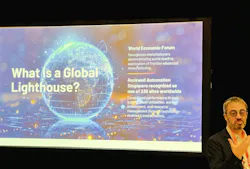
Rockwell Automation’s Singapore manufacturing facility was named a World Economic Forum Global Lighthouse Network facility in June 2026. This initiative showcases industrial sites that use Fourth Industrial Revolution technologies to drive productivity, resilience, sustainability, talent and customer centricity. They serve as guides—lighthouses if you will—for other manufacturers charting courses to smoother industrial sailing.
This Singapore facility serves as a “Rockwell on Rockwell” environment, where Rockwell Automation deploys technologies in its own manufacturing operations before scaling successful applications to other facilities. Eating your own dogfood, as the saying goes.
The facility uses multiple forms of AI across its operations, including machine learning, generative AI and agentic AI. And for predictive-maintenance strategies, Rockwell Automation aggregates hundreds of thousands of data points from controllers and its manufacturing execution system (MES), feeding 64 machine-learning algorithms that monitor a conveyor running between two levels of the plant. (Space is at a premium in Singapore, so when you build a factory, you build up.)
And, to put it frankly, everything is going swimmingly, according to Cyril Perducat, senior vice president and chief technical officer at Rockwell Automation, who provided a status update during Automation Fair 2026. He noted, proudly, that since the predictive-maintenance system was implemented at the Asian facility two years ago, the conveyor has not had a single instance of negatively impacting production.
He then spotlighted the “how” behind the successful processes.
- The facility uses a GenAI-powered maintenance copilot that combines plant and MES data, maintenance and troubleshooting information, equipment manuals and institutional knowledge captured from experienced technicians. Workers can query the system using text or voice. This reduced technician time-to-competency from about 12 months to four months and mean time-to-repair from 18 minutes to 12 minutes.
- Perducat noted how the plant has achieved a 25% reduction in spares inventory.
- The Singapore site uses a multi-agent quality-assurance system that brings together data from machines, control systems, visual inspections, vibration analysis, metrology and other sources to identify issues and recommend potential actions to technicians. Since implementation, the facility has achieved a 35% reduction in defects.
- Rockwell Automation even employs AI to analyze employee-transportation data throughout the region to optimize bus routes across facilities, including Singapore, resulting in more than $500,000 in transportation savings. Hail to the bus driver, the AI-empowered bus driver!
“It is important to constantly consider existing assets and processes,” the vice president explained, detailing the notion of recognizing where users “are” within each process and using that knowledge to inform next steps. Autonomation as a fluid journey, rather than something requiring fixed start and end points.
The end goal, ultimately, is efficiency. Efficiency in many forms, throughout many factors, resulting in different outcomes that result in greater reliability, enhanced sustainability efforts, freeing human personnel from tasks that are best handled by machines. Heck…even shorter bus routes for workers.
And while these approaches are certainly reliant on advanced automation tactics, at the core these efforts are, as Perducat describes them, “uniquely human.”
“We’re connecting the dots between seemingly unrelated things, based on our experiences to develop new ways to work,” he said, adding how these efforts are intended to move beyond merely processing data to fully informing larger strategies.
“Either you resist change or embrace change. And we want to embrace change with confidence,” he continued. “We are building what the future of factory operations looks like.”