Inside Symbotic’s automated warehouse: robotics, software and Rockwell integration
Produced with support from Rockwell Automation
This show takeover was sponsored by our Automation Fair coverage partner, Rockwell Automation. See more coverage on our Automation Fair page.
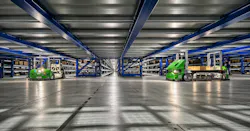
A case of groceries has a surprisingly complicated journey between a supplier and a supermarket shelf. At a distribution center operated by C&S Wholesale Grocers, that journey unfolds inside an eight-level automated storage system, where mobile robots retrieve individual cases, move them through the facility and deliver them for assembly into store-ready pallets.
During a media tour organized as part of Automation Fair 2026, international trade journalists got a firsthand look at the operation during one of their busiest timeframes. Located in Connecticut, the facility uses Symbotic's warehouse-automation technology, which combines autonomous mobile robots, robotic arms, lifts, storage structures and software to manage the flow of goods, while Rockwell Automation provides the control, motion and networking technologies that coordinate the system.
The tour took place at C&S, one of the largest wholesale grocery distributors in the United States, supplying independent and chain retailers through a nationwide network. Symbotic's customers include Albertsons, Walmart, Target and Medline.
Following the path of individual cases from receiving to shipment, the tour spotlighted how products are identified, stored, retrieved and assembled into mixed-product pallets for delivery.
Rosa Ciprian, who leads Symbotic's electrical-engineering team, framed the initial challenge behind the company's development. The goal, she said, was to create a more efficient path from inbound receiving to outbound shipping. “This company did not start in a lab; it started in a warehouse,” Ciprian said.
At the site, autonomous mobile robots, robotic arms, lifts, conveyors and software work in harmony across three outbound cells and two inbound cells connected by an eight-level storage structure.
Inbound processing and inventory capture
The process begins when pallets arrive from manufacturers and suppliers. Symbotic offers different inbound configurations, including pallet-based receiving and floor-loaded inbound systems for goods delivered directly in trailers.
Workers scan incoming pallets and remove their plastic wrapping before automated robotic arms take over. Articulated robot arms with payloads of 500 pounds lift complete layers of cases from the pallets, supporting them from underneath to reduce the risk of product damage.
David Clear, Symbotic vice president of sales, said the inbound cells at this facility were processing about 1,215 cases per hour each. Other installations can reach 1,700 cases per hour, depending on the products being handled.
The cases are then separated, or singulated, into individual units and passed through scanning tunnels. The scanning process captures a three-dimensional profile of each case, including its dimensions, weight and identifying information such as lot numbers and expiry dates. This information creates a digital record of the inventory and helps the system determine how each case should be stored and handled.
Cases with damaged packaging or other irregularities are diverted to reject lanes for inspection, repackaging or quality checks. They can then be manually reintroduced into the system.
Automated storage and retrieval
Following scanning, cases move through lift cells, which distribute them to the appropriate levels of the storage structure. The system has eight levels, each with a transfer deck connecting the storage aisles.
Symbotic's autonomous mobile robots, known as SymBots, operate within these levels. They collect individual cases from the lifts, transport them along the transfer decks and place them in storage locations. When an order is ready, the robots retrieve the required cases and return them to the outbound operation.
SymBots operate as a coordinated fleet under software management. Symbotic's AI-powered software directs their movements, manages inventory locations and sequences retrieval according to order requirements. Ciprian noted that the system’s software processes large volumes of operational data, enabling it to learn from activity across installations and inform operational decisions.
Storage locations are dynamic rather than predefined, Clear explained. Available shelf space can be combined to accommodate different case dimensions. Faster-moving products generally remain closer to outbound operations, while slower-moving inventory can be stored farther away. Business rules can also determine where specific products are placed.
The system had 155 robots operating across its eight levels. Clear said that the robots use rapid-charging capacitors as they move through the structure, allowing them to recharge without stopping for conventional charging cycles.
System integration and operational controls
The tour also highlighted the role of industrial controls in coordinating different technologies. The facility combines Symbotic-developed equipment, including its robots and storage structure, with third-party robotic arms and lifts supplied by other manufacturers.
Rockwell Automation provides the control, motion, drive and networking technologies that coordinate equipment across the installation, including third-party machinery and safety systems. Logix controllers serve as the control backbone, while Kinetix motion products and PowerFlex drives support equipment movement, including the lifts that transfer cases between storage levels. Allen-Bradley Stratix-managed switches connect the system's control and networking infrastructure, with Rockwell-supplied panels helping integrate Symbotic's automation with third-party equipment.
Clear described the division of responsibilities succinctly: “The bots are ours, the storage structures ours, and then we integrate everything together with the help of Rockwell Automation."
Outbound processing and intelligent pallet-building
The outbound process reverses the storage operation. SymBots retrieve individual cases and deliver them to lifts, which transfer the products to conveyors serving the outbound cells.
Before pallet-building, cases are buffered and sequenced according to their destination. The software uses store layout information to organize products into what Symbotic calls smart pallets. Products destined for the same store aisle can be grouped together, reducing the work required to unpack and replenish shelves at the receiving location.
The pallet-building process also considers product weight, dimensions, shape and packaging-crushability to determine placement and maintain load stability. Robotic arms assemble the pallets while a wrapping system secures the load during construction. Completed pallets are discharged for forklift collection and shipment.
At the facility, the outbound operation was processing up to 1,350 cases per hour. Pallet-construction takes about four to six minutes.
Extending automation beyond full-case handling
Ciprian then outlined two additional applications. Symbotic's BreakPack capability handles orders requiring quantities smaller than a full case. Cases are opened, individual items are picked and placed into totes, allowing mixed-product orders to be assembled alongside conventional case fulfillment.
The company is also developing its SymMicro system for micro-fulfillment in retail stores. Unlike the distribution-center operation, which primarily handles native cases, SymMicro uses totes to manage smaller quantities and support individual customer orders.
Ongoing partnership
Symbotic's backlog stands at $22.5 billion, according to Joshua Carroll, senior director of industrial controls at Symbotic. As the company expands its installations, its work with Rockwell Automation continues to expand in scope and complexity. “When you're growing that fast, you've got to have partners and products that are reliable, that actually perform well, along with a partner that can help you scale even in situations like COVID and the resulting supply-chain crisis,” he said.
The partnership also gives Rockwell Automation insight into the control requirements of large-scale warehouse-automation projects. Mark Buntin, senior account manager at Rockwell Automation, said Symbotic's pace of innovation has challenged his team to keep up with new demands from the system integrator. “Even though we are a technology company, they actually push us as a technology company to, in a sense, keep up with their innovation,” he said.
This partnership is tested in the machinery, software and controls needed to make a complex warehouse system work—and in how quickly both companies can adapt when demands change.