Securing digital operations in the age of AI
Produced with support from Rockwell Automation
This show takeover was sponsored by our Automation Fair coverage partner, Rockwell Automation. See more coverage on our Automation Fair page.
Entranced by all those shiny AI baubles for optimizing operations, closing skills gaps, and doing even more with even less? Well, not so fast because they require many added network connections, which means far more openings and vulnerabilities to cyber-probes, cyber-intrusions and potential cyber-attacks.
Protecting against these ever-evolving threats—and responding effectively when breaches occur—can seem like overwhelming tasks. These difficulties are compounded, of course, when users try to organize and analyze mounting volumes of information from expanding existing sources and multiplying new ones.
“There’s no shortage of data these days, so it’s a struggle to turn it into actionable insights—and do it securely at the same time,” said Tajaey Young, director of Secure Digital Operations at Rockwell Automation, at the kickoff of the Secure Digital Operations Summit on the opening day of Automation Fair 2026. “This is why Rockwell established our Secure Digital Operations Group, which provides strategy-advisory services, management-operations software to collect related data, and other cybersecurity services that users can scale to meet their needs.”
Young reported that comprehensive and adaptable cybersecurity is required to enable Rockwell Automation’s vision for future industrial operations that it expects will be increasingly intelligent, adaptive and autonomous. To succeed, these operations will need to be enabled by protective systems designed for agility, coordinated action and continuous learning. “These autonomous-operations systems will consist of a continuous learning loop that includes trusted content and skills for designing, operating and maintaining production processes and equipment,” he explained. “This loop will also cover physical artificial intelligence for sensing and acting, software-defined automations for analyzing, and orchestration functions for coordinating functions and activities.”
While establishing autonomous operations typically requires addressing people, governance and change-management issues, Young added that Rockwell’s version focuses on three primary capabilities:
- Operational resilience that protects infrastructure, systems and data, while creating the trust required for autonomy to scale. Its functions include operations technology visibility, risk and vulnerability management, protection and monitoring, response and recovery.
- Enterprise connectivity that provides operational context, continuity and traceability across the value chain. Its activities include product/production-lifecycle management, manufacturing execution systems (MES), quality, regulatory compliance and digital threads.
- Industrial intelligence that establishes trusted data foundations, and transforms operational data into insights and actions. It covers data architecture, data governance, analytics and AI.
Panelists weigh in on protections
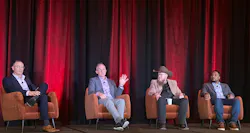
Following Young’s keynote was a panel discussion, “Vision to Value: Building the Foundation for Resilient, Autonomous Operations.” Moderated by Young, it included three of Rockwell Automation’s cybersecurity experts, namely George Young, vice president of Secure Digital Operations and founder of Kalypso, Shannon McKey regional vice president of Secure Digital Operations, and Stephen Birtiss, principal consultant.
“The digital journey that manufacturers are on now is different than previous enterprise transformations,” said George Young. “We’re now in the second phase of that transformation. The first was about gathering and transferring knowledge, but now we’re talking about delivering real value, using real advances and AI to unlock data and insights. Software and consulting don’t matter as much as they did before because users must have the in-house capability to drive value.”
Birtiss agreed that previous concentrations on technology and optimization have shifted to build in capabilities that can achieve more substantial efficiencies and value. “Users and suppliers spent 10 years and more focusing on optimizing assets, but those efforts weren’t activated across each other,” he said. “Now they’re looking for infrastructures and data that can be stitched together and allow them to move from automation to autonomy.”
While AI capabilities are part of overall digital transformations, George Young reported that AI can also benefit from the latest data science and IT-based capabilities to see into data sets more deeply and quickly, so users can make better decisions sooner.
“Data science can also help cybersecurity because, if protections are built on data, then users don’t have to be locked into one solution,” explained Georgie Young. “For example, prompt-based designs and composable software are going to be the future, so cybersecurity needs to be part of those functions as well. In fact, Rockwell’s new FactoryTalk Conductor platform will be able to connect with and help make sure core solutions are secure, such as our Plex MES platform, Emulate3D and Pavilion model predictive control (MPC) software.”
Birtiss added that, “AI is an amplifier, but it has to come last and be put on top after users have decided what they’re really trying to achieve. Are they trying to calculate costs or identify losses? Are they trying to decide what capabilities to build, and what equipment and tools they’ll need to implement? AI can certainly help, but users must first decide what requirements they’re trying to meet. AI needs that secure foundation.”
Meanwhile, McKay reported that this secure foundation is especially necessary because AI appears to be even more adept at helping bad actors launch cyber-attacks. “Because AI is so fast, it quickly lets hackers create increasingly realistic impersonations and phishing emails that look more and more authentic,” said McKay. “It also lowers the barrier for less-experienced hackers, and helps them launch more sophisticated cyber-attacks.”
Fortunately, McKay added the good news that AI can also help improve cybersecurity protections. “It can identify anomalies quicker, and enable cybersecurity triage and mitigation efforts,” he explained. “However, these new capabilities must be built on good, traditional cybersecurity practices that are already in place, such as updated passwords and authentications, network segmentation into functional zones separated by managed Ethernet gateways used as firewalls, and network-traffic evaluation to detect anomalies and potentially malicious communications.”
Beyond treating data and networks as strategic assets that must be protected, the panelists agreed that cybersecurity also depends on understanding the differences between OT and IT’s missions, priorities and resulting cybersecurity goals.
“Losing an email server is a problem, but there’s a lot more at stake in manufacturing. Unplanned downtime on plant-floors can mean personnel and machine-safety incidents, as well as lost production, reduced quality and reputational damage,” explained McKay.
He added, “The problem is, if 15-20 machines are connected and data-rich, they may be attached to many legacy devices that weren’t previously networked, and still don’t have cybersecurity protections. This is a common problem, but it’s only grown as more components are added to networks, which are often shared by OT and IT. This is why you can’t have autonomous machines and systems without a trusted and disciplined cyber-hygiene program.”
Because cybersecurity requirements shift along with evolving cyber-threats and the different priorities of the industries and users affected, Birtiss reported that it’s essential not to skip the planning step for what protections may be needed. “Users and their organization may have a common vision for cybersecurity, but they often develop different pilot projects and platforms that can’t be scaled because of their differences. This is where we can help tackle what they want to do, seek out what will work, and prove it. It’s also important to take a human approach, so participants will learn, understand, adopt and practice it as a regular part of their operations.”
Once initial cybersecurity priorities and planning are settled, McKay added that cybersecurity protections should be built in from the beginning, just like the safety functions that are part of risk assessments and hazardous-operations analyses.
“Cybersecurity shouldn’t be the gate at the end. It should be part of the roadmap from the beginning,” stressed McKay. “Cybersecurity risk assessments start with an inventory and assessment of assets, process applications and facilities. However, because there are many single-point cybersecurity solutions out there, I recommend developing long-term, programmatic policies and procedures that can evolve as needed.”
About the Author
 Jim Montague